


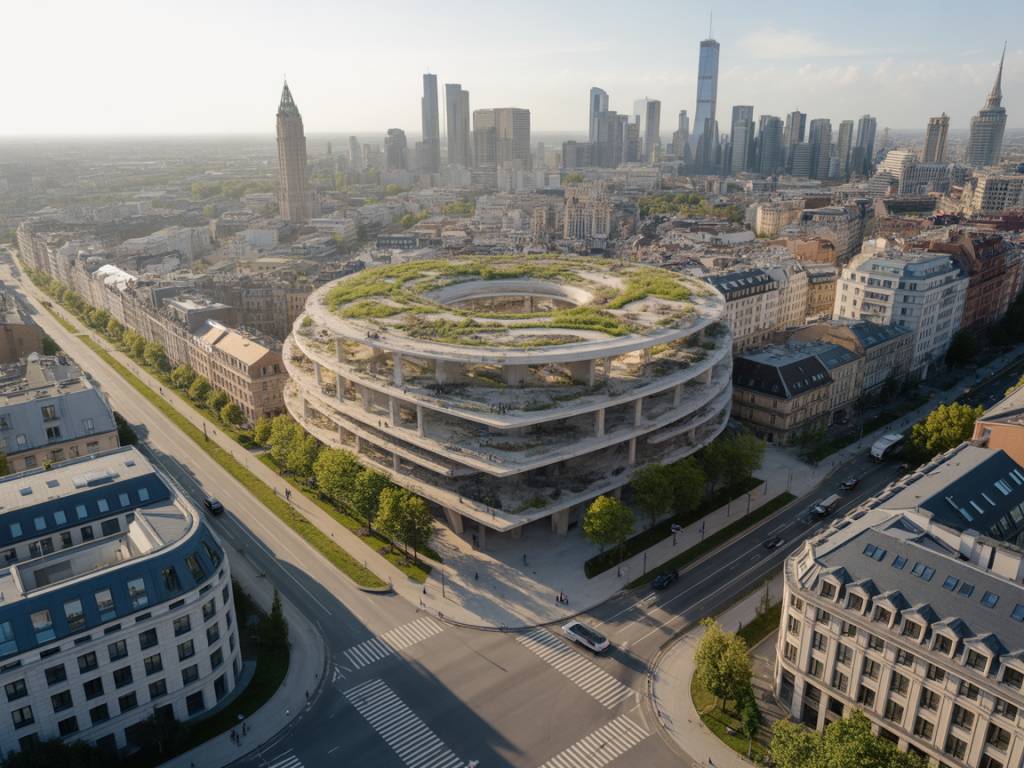
Every year, the construction sector consumes roughly 50% of all raw materials extracted globally and generates nearly a third of total waste. As cities expand at unprecedented speed, this linear approach — extract, build, demolish, discard — is becoming ecologically and economically unsustainable. Circular construction offers a radical rethink: one where buildings are designed to give materials a continuous life, not a one-way trip to landfill. For urban developers, planners, and policymakers, understanding how circular construction is redefining urban development through sustainable building materials is no longer optional — it is urgent.
What Circular Construction Really Means for Urban Development
Circular construction applies the principles of the circular economy directly to the built environment. Rather than following the traditional « take, make, dispose » model, it treats every building component as a future resource. This means thinking about disassembly before a single wall is raised, and tracking materials across their entire lifecycle — from extraction to occupation to eventual reuse.
The stakes for cities are significant. Urban areas already account for around 70% of global carbon emissions, and construction activity is among the largest contributors. Shifting to circular models can dramatically reduce embodied carbon, shrink waste volumes, and create more resilient local economies. Cities including Amsterdam, Copenhagen, and Singapore are already embedding circular principles into their long-term urban strategies, setting measurable targets for material reuse in public infrastructure projects.
Circular Construction: Redefining Urban Development Through Sustainable Building Materials in Practice
The sustainability of a circular building rests on the quality and recoverability of its materials. Choosing the right materials at the design stage is what separates genuinely circular buildings from greenwashed alternatives.
High-Performance Recycled and Bio-Based Materials
- Recycled Concrete Aggregate (RCA): Crushed from demolished structures, RCA can substitute up to 30% of natural aggregates in new builds without compromising structural integrity, significantly cutting quarrying demand.
- Cross-Laminated Timber (CLT): A renewable structural material that sequesters carbon throughout its lifespan. CLT buildings can store an estimated 0.8 tonnes of CO₂ per cubic metre of timber used.
- Hempcrete and Rammed Earth: Locally sourced, biodegradable, and non-toxic, these materials deliver excellent thermal mass and insulation — ideal for low-energy urban housing.
- Recycled Steel: Producing steel from scrap requires up to 75% less energy than virgin production, making it one of the most impactful material choices in large-scale urban projects.
- Repurposed Glass and Plastics: Increasingly used for cladding, insulation boards, and even load-bearing components, diverting thousands of tonnes of waste from landfills annually.
Each of these materials performs best when procurement is tied to regional supply chains, cutting transport emissions and supporting local economies simultaneously.
Designing for Disassembly: The Principle That Changes Everything
Material choice alone is not enough. Circular construction requires that buildings be designed from the outset to be taken apart cleanly and efficiently. This principle — designing for disassembly — is what enables true material recovery at end of life.
Practical measures include prioritising mechanical fixings over adhesives, using standardised modular components, and maintaining detailed records of every element installed. Modular steel frames, demountable timber panels, and clip-on façade systems can be removed intact and redeployed in future projects, potentially retaining 80–90% of their original value. The shift from permanent to reversible construction is, in many ways, the cornerstone of circular urban development.
The Economic Case: Why Circular Construction Makes Financial Sense
The misconception that sustainable building is simply more expensive does not hold up under scrutiny. While upfront design costs may be marginally higher, the circular model generates measurable savings across the building lifecycle.
- Reduced material procurement costs through reuse of salvaged components
- Lower waste management and landfill fees during demolition and renovation
- Improved energy performance reducing long-term operational costs
- Higher asset value as green certifications become standard investor expectations
- Job creation in deconstruction, material recovery, and urban retrofitting sectors
A 2022 Ellen MacArthur Foundation report estimated that circular construction strategies could reduce material costs in urban development by up to 23% by 2030. For municipalities managing tight infrastructure budgets, these are figures that cannot be ignored.
Policy Frameworks Accelerating the Circular Shift
Regulatory environments are beginning to catch up with the ambitions of forward-thinking developers. Amsterdam’s Circular Strategy 2020–2025 commits to halving the use of new raw materials in city construction by 2030. The EU Circular Economy Action Plan mandates life-cycle thinking across infrastructure procurement and enforces eco-design requirements on construction products. The UK’s own Net Zero Strategy increasingly references circular principles as a mechanism for reducing embodied carbon in new buildings.
Building codes that reward material passports, incentivise deconstruction over demolition, and certify recycled content levels are becoming more common. For developers operating in urban markets, aligning early with these frameworks is both a compliance necessity and a competitive advantage.
Digital Tools Driving Smarter Circular Urban Planning
Technology is making circular construction increasingly precise and scalable. Building Information Modelling (BIM) enables architects to document every component — its material, origin, dimensions, and reuse potential — creating a digital blueprint for future deconstruction. When paired with digital material passports, this data dramatically improves the efficiency of material recovery during renovations or end-of-life disassembly.
AI-driven platforms are now being used to match salvaged materials from demolition sites with the specifications of new construction projects in real time, creating functioning secondary material markets in cities. Smart sensors embedded in structural components can also monitor performance over decades, informing maintenance decisions and extending usable lifespans.
Global Projects Setting the Standard
- The Edge, Amsterdam: A flagship commercial building integrating modular components, reused materials, and predictive energy management — widely cited as one of the most sustainable office buildings in the world.
- BAMB Reversible Building Initiative (Belgium): An EU-funded project delivering buildings explicitly designed for multiple use cycles with near-zero material waste at each transition.
- Arup Materials House: A prototype demonstrating 100% reusable components, challenging the industry assumption that structural performance requires permanent assembly.
These projects share one defining characteristic: circularity was embedded at the earliest design stage, not added as an afterthought.
Overcoming the Barriers to Wider Adoption
Scaling circular construction across entire cities requires addressing real obstacles: fragmented secondary materials markets, inconsistent certification standards, limited contractor familiarity with deconstruction techniques, and the cultural inertia of an industry accustomed to doing things the conventional way. Awareness among developers remains uneven, and access to high-quality recycled materials is still geographically inconsistent.
Yet the trajectory is clear. As embodied carbon reporting becomes mandatory in more jurisdictions, as resource prices rise, and as urban populations demand greener living environments, circular construction will shift from niche innovation to industry baseline. The collaboration needed — between architects, urban planners, material scientists, technology providers, and local governments — is already beginning to take shape. Those who move now will define what the next generation of cities looks like.